Databricks Essentials: From Zero to Data Engineer
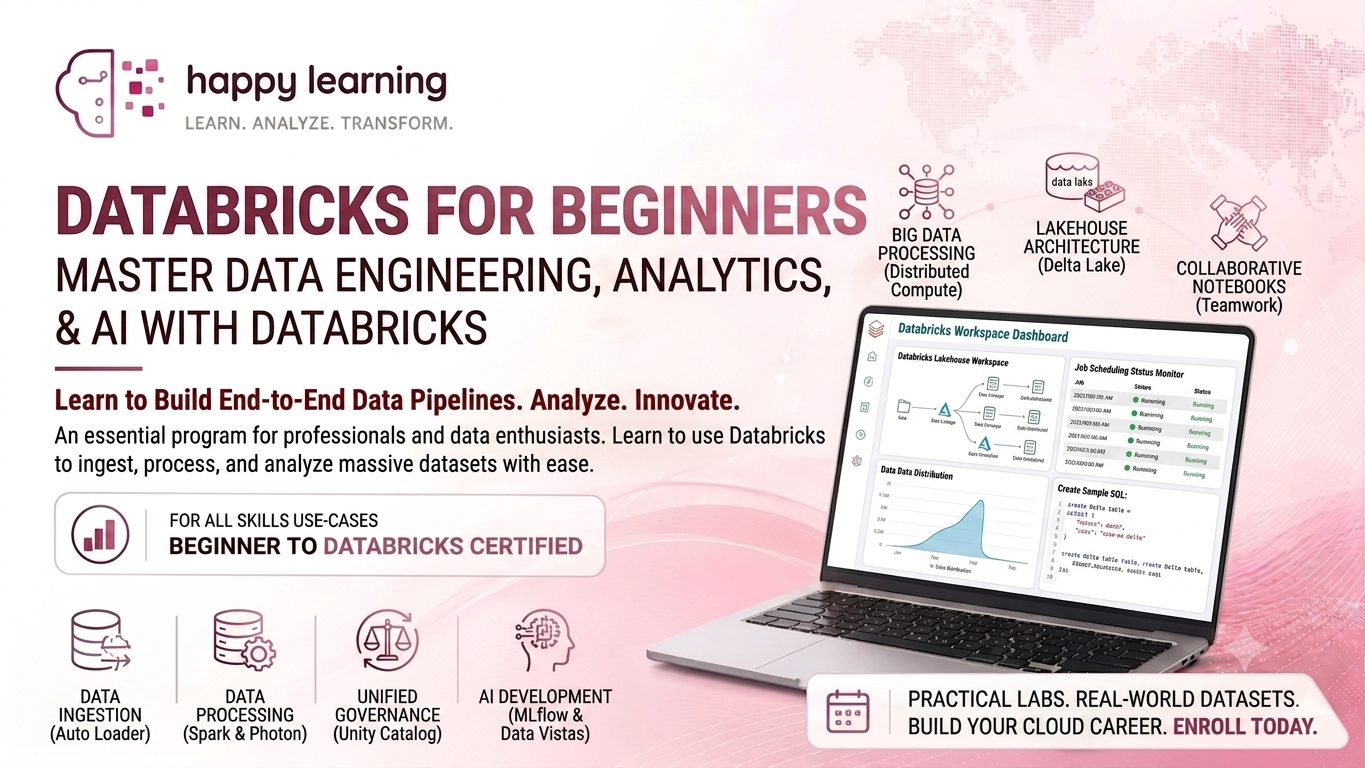
Course Content
Introduction to Databricks
Databricks is a unified data and AI platform built on Apache Spark that enables organizations to ingest, process, analyze, and govern data at scale. It combines data engineering, analytics, machine learning, and AI capabilities in a single Lakehouse architecture, helping teams collaborate efficiently and build data-driven solutions.
What is Databricks?
Why Databricks is Popular
Databricks Lakehouse Platform
Databricks Use Cases
Course Roadmap
Getting Started with Databricks
In this module, you will learn how to set up and navigate the Databricks environment, understand its core components, create and manage compute resources, and work with notebooks to run your first data processing and analytics workloads. This foundation will prepare you for building data engineering, analytics, and AI solutions on the Databricks platform.
Creating a Databricks Workspace
Understanding the Workspace Interface
Notebooks Overview
Catalog Explorer
Creating Your First Notebook
LAB: Run Your First Databricks Notebook
Databricks Compute
In this module, you will learn about Databricks compute resources, including clusters, SQL warehouses, and serverless compute. You will understand how compute powers data processing workloads, how to configure and manage resources efficiently, and how to optimize performance and costs for different use cases.
What is Compute?
Clusters vs SQL Warehouses
Creating and Managing Clusters
Understanding Databricks Runtime
LAB: Create and Start a Cluster
Working with Notebooks
In this module, you will learn how to create, organize, and collaborate using Databricks notebooks. You will explore notebook features, run code in multiple languages, visualize data, share insights with team members, and build interactive workflows for data analysis and engineering tasks.
Notebook Basics
Markdown in Notebooks
Magic Commands
Running SQL and Python
LAB: Create a Multi-Language Notebook
Introduction to Apache Spark
In this module, you will learn the fundamentals of Apache Spark, the distributed processing engine that powers Databricks. You will understand how Spark processes large-scale data efficiently, explore its core concepts such as DataFrames and transformations, and learn how it enables fast and scalable data engineering and analytics workloads.
What is Apache Spark?
Spark Architecture (High Level)
Driver and Executors
Distributed Processing Basics
PySpark Fundamentals
In this module, you will learn the fundamentals of PySpark, the Python API for Apache Spark. You will explore DataFrames, transformations, actions, and basic data processing techniques to efficiently work with large datasets and build scalable data engineering solutions in Databricks.
Creating DataFrames
Reading Data from Files
Basic Transformations
Filtering and Sorting Data
Writing Data
LAB: Load and Transform a CSV File
Spark SQL Fundamentals
In this module, you will learn how to use Spark SQL to query, transform, and analyze data within Databricks. You will explore SQL fundamentals, work with tables and views, perform aggregations and joins, and leverage SQL to build efficient data analytics and reporting solutions.
Creating Tables
SELECT Statements
Filtering Data
Aggregations
Joins
LAB: Sales Analysis Using SQL
Delta Lake Basics
In this module, you will learn the fundamentals of Delta Lake and how it enhances data reliability and performance in Databricks. You will explore Delta tables, ACID transactions, schema enforcement, time travel, and data versioning to build robust and scalable data pipelines.
What is Delta Lake?
Benefits of Delta Tables
ACID Transactions
Time Travel Overview
LAB: Create and Query Delta Tables
Medallion Architecture
In this module, you will learn the Medallion Architecture approach for organizing and refining data in Databricks. You will explore the Bronze, Silver, and Gold layers, understand how data flows through each stage, and learn best practices for building scalable, reliable, and maintainable data pipelines.
Bronze Layer
Silver Layer
Gold Layer
Data Flow Between Layers
LAB: Build a Simple Bronze → Silver → Gold Pipeline
Databricks Workflows
In this module, you will learn how to automate and orchestrate data pipelines using Databricks Workflows. You will create, schedule, and monitor jobs, manage task dependencies, and build reliable end-to-end workflows for data engineering and analytics processes.
Introduction to Jobs
Scheduling Notebooks
Monitoring Job Runs
LAB: Schedule a Daily Job
Databricks SQL & Dashboards
In this module, you will learn how to use Databricks SQL to analyze data and create interactive dashboards. You will explore SQL Warehouses, write analytical queries, build visualizations, and design dashboards that help stakeholders gain insights and make data-driven decisions.
Introduction to Databricks SQL
Creating Visualizations
Building Dashboards
LAB: Create a Sales Dashboard
Beginner End-to-End Project
In this module, you will apply the concepts learned throughout the course to build a complete end-to-end data engineering project in Databricks. You will ingest data, transform it using PySpark and Spark SQL, implement the Medallion Architecture, create Delta tables, automate workflows, and build dashboards to deliver actionable business insights.
Retail Sales Analytics Project
Load Raw Data
Create Bronze Tables
Build Silver Transformations
Create Gold Reporting Tables
Build Dashboard
Schedule Pipeline
Enable AI/BI Genie
Databricks Interview Preparation
In this module, you will review key Databricks concepts commonly asked in interviews. You will cover Databricks architecture, Apache Spark, PySpark, Delta Lake, Medallion Architecture, Workflows, SQL, and real-world scenario-based questions to help you prepare confidently for data engineering and analytics roles.
Databricks Fundamentals Interview Questions
Apache Spark Interview Questions
PySpark Interview Questions
Delta Lake Interview Questions
Databricks SQL Interview Questions
Scenario-Based Questions
Beginner Mock Interview